New Delhi says Jammu and Kashmir remains an inseparable part of India
India firmly rejects Pakistan’s claims on Kashmir at the United Nations
India strongly responded to Pakistan at the United Nations Security Council (UNSC), reaffirming that Jammu and Kashmir is an integral part of the country and accusing Pakistan of repeatedly using international platforms to promote what it described as a misleading narrative. The response came during a high-level debate at the UNSC, where India also raised concerns about cross-border terrorism and reiterated its position on the Indus Water Treaty.
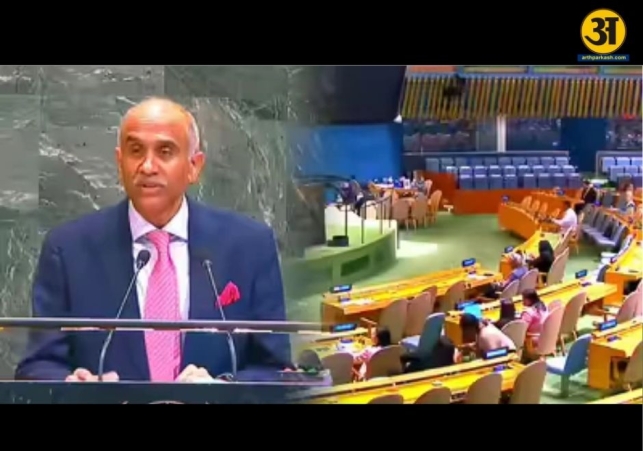
The remarks were made by India’s Permanent Representative to the United Nations, Ambassador Parvathaneni Harish, during the Security Council’s High-Level Open Debate on “Natural Resources Governance: the Foundation of Peace, Security and Prosperity.” The debate focused on the role of natural resources in promoting peace, stability and economic development, but discussions also touched upon broader regional issues after Pakistan raised concerns related to Jammu and Kashmir.
India’s response was direct and firm, with Ambassador Harish stating that the country could not remain silent when Pakistan used the forum to present what New Delhi considers inaccurate claims regarding Kashmir.
According to India, the constitutional and legal status of Jammu and Kashmir is settled and not open to debate. The Indian envoy emphasized that the region has always been an integral part of India and will continue to remain so.
The exchange once again highlighted the continuing differences between India and Pakistan on the Kashmir issue, a subject that has remained a major point of contention between the two neighbours for decades.
India responds to Pakistan’s remarks
During the UNSC debate, Ambassador Harish said India had not intended to discuss bilateral disputes. However, he stated that Pakistan’s comments made it necessary for India to respond.
He accused Pakistan of using an international platform to advance a narrative that India considers misleading and disconnected from the realities on the ground.
According to the Indian envoy, Jammu and Kashmir’s position within the Indian Union is based on constitutional and legal principles that have already been established. He said that Pakistan continues to ignore these realities while attempting to raise the issue in international forums.
India maintained that Jammu and Kashmir remains an inseparable and inalienable part of the country. The envoy stressed that this position is not new and has consistently been India’s official stand.
The statement was aimed at countering Pakistan’s repeated efforts to draw international attention to the Kashmir issue. India has long maintained that all matters related to Jammu and Kashmir are internal issues or bilateral matters that should not be internationalised.
ALSO READ: US launches fresh strikes on Iran as tensions rise across the Gulf region
ALSO READ: Ram Temple Trust resumes donation counting with new supervision amid ongoing probe
The Indian representative also referred to areas that India claims remain under Pakistan’s control. He said the only unresolved issue regarding Jammu and Kashmir concerns territories that India regards as being under illegal occupation by Pakistan.
By making this point, India reiterated its longstanding position that any discussion on Kashmir should include concerns about territories that it says are occupied by Pakistan.
The remarks reflected New Delhi’s broader diplomatic strategy of firmly defending its sovereignty and territorial integrity whenever the Kashmir issue is raised at global forums.
Terrorism and treaty concerns highlighted
Apart from addressing Kashmir, Ambassador Harish also spoke about terrorism and its impact on relations between India and Pakistan.
India accused Pakistan of repeatedly using cross-border terrorism as an instrument of state policy. The envoy argued that meaningful cooperation between countries cannot be achieved in an environment where terrorism continues to be used to target neighbouring nations.
This issue has remained a major source of tension between the two countries for many years. India has frequently raised concerns about terrorist groups operating from Pakistani territory and has called for stronger action against such organisations.
Linking the issue to broader regional cooperation, Harish said trust and goodwill are essential for productive engagement between countries. According to him, such trust becomes difficult when security concerns continue to exist.
The Indian envoy also referred to the Indus Water Treaty, one of the most significant agreements between India and Pakistan. Signed in 1960 with the support of the World Bank, the treaty governs the sharing of river waters between the two countries.
Harish stated that India’s position on the treaty remains clear and consistent. He emphasized that cooperation under any agreement requires mutual trust and goodwill.
His comments suggested that continued tensions and concerns over terrorism inevitably affect the broader atmosphere needed for successful cooperation between neighbouring countries.
The discussion on the treaty comes at a time when relations between India and Pakistan remain strained, with limited diplomatic engagement and ongoing disagreements over security and political issues.
In his closing remarks, the Indian envoy urged Pakistan to focus on addressing its own domestic challenges rather than directing criticism toward India at international forums.
He said that Pakistan would better serve its citizens by concentrating on internal development and governance issues instead of repeatedly raising allegations against India.
The exchange at the United Nations once again demonstrated the deep divisions between the two countries on issues related to Kashmir, security and regional cooperation. While both nations continue to present their positions before international audiences, their differences remain unresolved.
For India, the latest statement was another opportunity to reiterate its long-standing position that Jammu and Kashmir is an integral part of the country and that any attempts to question its status are unacceptable. At the same time, New Delhi used the platform to highlight concerns about terrorism and the need for trust-based cooperation in regional affairs.
As diplomatic engagements continue at international forums, India’s message at the UNSC made it clear that its stance on Jammu and Kashmir remains unchanged. The country maintains that the region’s status is settled under its Constitution and laws, while also calling on Pakistan to address issues that India believes are obstacles to peace and stability in the region.
Related News